
Module 1 · Brand Strategy: Think Before You Draw
Turn your transcript into a strategy document
This is the payoff. You paste one carefully built prompt, then your transcript, and AI hands back a clean, professional 10-section brand strategy document — in your own words, inventing nothing. It’s the first real file of your Brand Package, and it’s the one that quietly powers everything after it.
The synthesis prompt
Copy this exactly — don’t paraphrase it, every line is doing a job. Paste it into ChatGPT (or Claude), then paste your transcript where it says [PASTE YOUR TRANSCRIPT HERE], and send:
Copy this whole prompt, then paste your transcript at the bottom
You are an expert brand strategist trained in Donald Miller's StoryBrand
framework. I'm a business owner. Below are 15 questions I was asked and the
transcript of my spoken answers. Your job is to turn my answers into a clear,
professional Brand Strategy Document.

CRITICAL RULES — follow these exactly:
1. Use ONLY the information in my transcript. Do not invent facts, services,
   prices, credentials, or results I did not say. This document will be used to
   write my real website — accuracy matters more than sounding impressive.
2. If a section needs information I did not clearly provide, write:
   "[Not covered in your answers — consider adding this]" and briefly say what to
   add. Never fill a gap with a guess.
3. For the "Writing-style / voice" and "Founder bio" sections, preserve MY actual
   words, phrases, and tone from the transcript. Quote me where it helps. Do not
   make me sound corporate if I don't talk that way.
4. Clean up rambling into clear prose, but do not change my meaning.
5. Keep it plain and scannable — clear headings, short paragraphs and bullets. I
   will paste this into other AI tools later, so structure matters.

Produce the document with EXACTLY these 10 sections and headings:

1. Business Model — what I do (one plain paragraph) and how I make money.
2. Services / Products — a list, each with what it is, who it's for, and rough
   price.
3. StoryBrand Framework Analysis — with these labelled sub-parts:
   - Character (my customer / the hero) and what they most want
   - Problem — External (the practical problem)
   - Problem — Internal (how it makes them feel)
   - Problem — Philosophical (why it's wrong they should deal with it)
   - Guide — Empathy (what I understand about them) and Authority (my proof:
     experience, results, credentials)
   - The Plan (the simple 3–4 steps to work with me)
   - Call to Action — Direct (the main action) and Transitional (a low-commitment
     first step)
   - Success (the happy ending for my customer)
   - Failure / Stakes (what it costs them to do nothing)
4. Target-Audience Analysis — who they are, what they value, how they decide, their
   key pain points.
5. Primary Message & Positioning — my one-sentence "what I do, for whom, why I'm
   different," plus how I stand apart from competitors and the 2–3 messages that
   must always come through.
6. Brand Personality & Emotional Register — my brand's personality, the emotions
   customers should feel, my 5 brand words, and any colour/mood/brands-I-admire
   cues I mentioned.
7. Writing-Style / Voice Guidelines — formal vs casual, sentence style, signature
   words/phrases I use, and words I never use. Use my real voice.
8. Instructions for Writing Website Copy — a short brief any writer or AI can
   follow: lead with the customer's problem, position me as the guide, use my Plan
   as the steps, always end with my Direct CTA, keep the Transitional CTA visible,
   write in my voice from Section 7, and never claim results not listed in
   Section 3.
9. Founder Bio — my story and why I started this, my relevant experience, and a
   short "about me" paragraph in both first person and third person.
10. Brand Quick-Reference — ONE page: who I help, what I do, my one-liner, my
    customer's core problem, my promise, my voice in 5 words, and my main CTA.

After the document, add a short section titled "Questions to sharpen this" with the
3–5 places where my answers were thin or contradictory, phrased as follow-up
questions I can answer to strengthen the doc.

Here are the 15 questions and my transcript:
[PASTE YOUR TRANSCRIPT HERE]Why this prompt works (in plain English)
Three design choices make it trustworthy instead of just impressive:
- It can only use your transcript. Rule 1 forbids inventing services, prices, or credentials. A brand doc that makes things up is worse than none — you’d build a website on fiction. This one stays honest.
- It flags gaps instead of guessing. Where you were thin, it writes
[Not covered in your answers]rather than smoothing over the hole. Those flags are a gift — they show you exactly what to firm up next lesson. - It keeps your voice. For the bio and voice sections, it’s told to preserve your actual words and quote you. That’s what makes this richer than any form — it sounds like you, because it is you.
What the 10 sections are
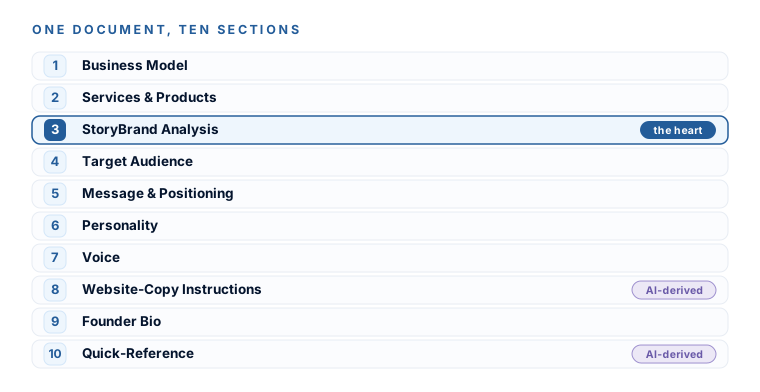
You’ll get all ten back at once. Section 3 (the StoryBrand analysis) is the heart. But note two special ones:
You never answered a question “for” Section 8 (Instructions for Writing Website Copy) or Section 10 (the one-page Quick-Reference). The AI derives them from everything else — that’s by design. Section 8 is the operating manual your future website copy runs on; Section 10 is the single page you’ll paste into AI most often. Don’t be surprised to see content you didn’t “write” — that’s the machine doing its job.
Save it — this is file #1
Save the whole output as brand-strategy.md (or a plain document). This is the first file of your Brand Package — and the single most valuable one, because it’s what every later decision checks itself against.
The prompt asks the AI to finish with a short “Questions to sharpen this” list — the 3–5 spots where you were thin or contradictory. Don’t act on those yet. That list is the exact fuel for the next and final lesson of this module.
You have a complete 10-section brand strategy document, in your own voice, saved as your first Brand Package file — with a short list of “questions to sharpen this” waiting at the bottom. Next: make it true, then lock it.