
Module 1 · Brand Strategy: Think Before You Draw
The 15-question brand interview
Meet the tool that does the heavy lifting: a 15-question interview about your business. Answer these out loud — generously, ramblingly — and you’ll have said everything a full brand strategy needs. No frameworks to learn, no boxes to fill. Just fifteen honest answers, talking like you would to a friend who’s never heard of your business.
The clever bit: the doc was designed first
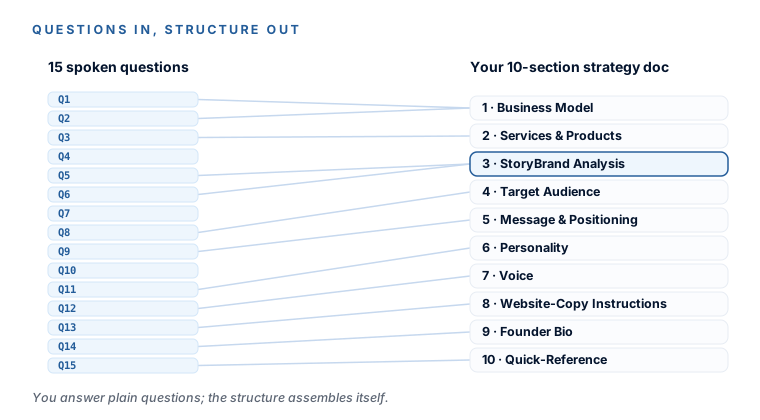
Here’s the trick under the hood. We didn’t write fifteen random questions. We designed the ten-section strategy document first, then reverse-engineered the questions so that thirty minutes of you talking contains everything those ten sections need. You never have to think about “positioning” or “brand architecture” — you just answer plain questions, and the structure assembles itself.
Why out loud, not typed
This matters more than it sounds. When you speak your answers, the transcript keeps your real cadence — your phrasing, your rhythm, the way you actually describe what you do. The document deliberately preserves that voice, and that’s exactly what makes it better AI context than any typed form could ever be. A typed answer is you being careful. A spoken answer is you being you.
The 15 questions
Read them now so nothing catches you off guard when you record. Under each is a quiet note on what it’s really pulling out of you — you don’t need to think about that while answering, it’s just so you can see the machine working.
The facts (Q1–2)
What you sell, and how the money actually works.
The story (Q3–8)
Your hero, their three-layer problem, the success and the stakes.
Trust & the path (Q9–12)
Why you, the plan, the ask, and the competition.
Personality & voice (Q13–15)
Your five brand words, your visual gut-feel, and how you talk.
- Q1. “Tell me the story of your business — what do you do, who are you, and how did it come to exist?”
Pulls out: your business model, your founder story, and the origin. - Q2. “Walk me through exactly what you sell — every service or product, roughly what each costs, and how you actually make your money.”
Pulls out: your list of offerings and how the money works. - Q3. “Picture your single ideal customer as one real person — who are they, what’s their life like, and what do they most want?”
Pulls out: the hero of your story and who you’re really for. - Q4. “What’s the real, practical problem you solve for that person — the thing they’d say out loud they need fixed?”
Pulls out: the external problem and the seed of your one-liner. - Q5. “Before they find you, how does that problem make them feel day to day — frustrated, overwhelmed, embarrassed, stuck?”
Pulls out: the internal, emotional problem. - Q6. “Why do you think it’s just plain wrong that they should have to put up with this problem at all?”
Pulls out: the philosophical problem — the ‘it shouldn’t be this hard’ belief. - Q7. “Now picture you’ve helped them and it went perfectly — what does their life or business look and feel like afterwards?”
Pulls out: success — the happy ending you deliver. - Q8. “And if they do nothing — never solve this — what does that cost them in time, money, stress, or missed chances?”
Pulls out: failure and stakes — the urgency. - Q9. “Why should this person trust you specifically? What do you deeply understand about their situation, and what results, experience, or proof back you up?”
Pulls out: you as the guide — empathy plus authority — and credentials for your bio. - Q10. “If someone decides to work with you, what are the simple steps — what happens first, then next, then after that?”
Pulls out: the plan. - Q11. “What’s the one main action you want people to take — and is there an easier, no-pressure first step you could offer someone who isn’t ready yet?”
Pulls out: your direct call to action and a gentler transitional one. - Q12. “Who else could your customer choose instead of you — competitors or the ‘do nothing / do it themselves’ option — and what makes you genuinely different or better?”
Pulls out: your positioning and what sets you apart. - Q13. “If your brand were a person walking into a room, what would they be like — and what five words would you want customers to use to describe the feeling of dealing with you?”
Pulls out: your brand personality and your five brand words. These become your logo and colour prompts. - Q14. “What colours, moods, or existing brands do you love the feel of — and are there any looks or brands you’d hate to be mistaken for?”
Pulls out: your visual direction — a direct bridge to your logo and colours. - Q15. “How do you actually talk to your clients — formal or casual? Any words, phrases, or little jokes you use all the time, and anything you’d never be caught saying?”
Pulls out: your voice, including the ‘words we never use’ list.
Notice how much rides on Q13 and Q14 — your five brand words and your visual gut-feel. Answer those two with extra care. In two modules’ time, they literally become the prompts you feed the AI to generate your logo.
How to record (the one instruction)
Ship this with the questionnaire, and follow it to the letter — it’s the whole method:
Don’t write anything. Find 30 quiet minutes, open your phone’s recorder, read each question out loud, then answer it like you’re explaining your business to a friend who’s never heard of it. Ramble — more is better; the AI will tidy it up. If a question doesn’t apply, say so and move on. Say the question number before each answer (“Question 3…”) so the transcript stays organised.
Download the questionnaire — all 15 questions plus the recording instructions, one clean page — and keep it open on the next lesson while you record:
DownloadYou’ve read all 15 questions, you’ve got the download, and you understand why you’ll answer out loud instead of typing. You’re not filling in a form — you’re having a good conversation about your business, on the record. Next: actually recording it.
More learning resources
Still want another angle? These are hand-picked and vetted to line up with this lesson — from creators and sites worth your time.