
Module 1 · Brand Strategy: Think Before You Draw
Review, critique, and lock it
Your strategy doc is a strong first draft — but it’s still “AI output.” This lesson turns it into true: you read it with a critical eye, answer its own follow-up questions, run one honest critique, fix the gaps, and then lock it. From that moment, this document outranks your opinions on every brand decision to come. That’s the whole point of building it.
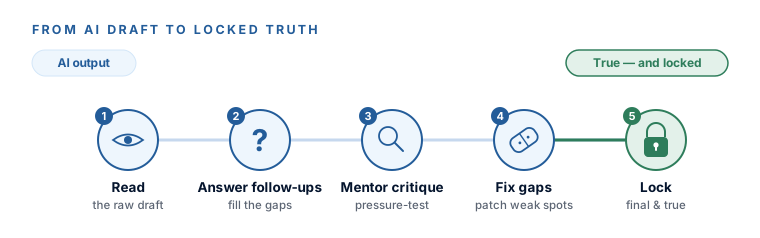
Step 1 — Read it once, mark what isn’t you
Read the whole document through, slowly, out loud if you can. You’re listening for one thing: anything that doesn’t sound like you. A phrase too corporate, a claim slightly too big, a “value” you don’t actually hold. Highlight each one. The AI cleaned up your rambling — occasionally it cleaned a little too hard and sanded off something real. Catch those now.
Step 2 — Answer the doc’s own “questions to sharpen this”
Remember that list the prompt left at the bottom? Those are the 3–5 places your answers were thin or contradictory. Answer them — out loud again, or typed, whatever’s faster — then paste your answers back into the chat and ask it to regenerate the affected sections:
Copy this after you've answered the follow-ups
Here are my answers to the "Questions to sharpen this." Update the strategy document using ONLY these new answers plus my original transcript — same rules as before: don't invent anything, keep my voice, flag anything still missing. Show me just the sections that changed.

My answers:
[PASTE YOUR ANSWERS TO THE SHARPENING QUESTIONS HERE]
Step 3 — Run the mentor loop
Now put on the mentor habit from Module 0. Don’t ask “is this good?” — ask it to find what’s weak. This is the blind-spot prompt from your Mentor Prompt Library, aimed at your strategy:
Copy this — the strategy blind-spot check
You are a blunt, experienced brand strategist reviewing this brand strategy document before it gets used to build a real website. Do not reassure me. Answer honestly:
1) What's the single weakest or vaguest part of this strategy, and why?
2) What's missing that a strategist would expect to see for a business like mine?
3) What would a sharp competitor or a skeptical customer push back on here?
Give me only the 3 issues that matter most, each with a specific fix I could make today.
Run that critique twice and keep only the points that show up both times — AI critique can contradict itself between runs. Trust the specific callouts (“your one-liner never says who it’s for”); ignore the vague filler (“it lacks clarity”). You’re the one who decides — it’s a sharp pair of eyes, not the boss.
Step 4 — Fix the gaps (or choose to accept them)
Go back to every [Not covered in your answers] flag. For each, either fill it in (paste the detail, regenerate) or consciously decide it doesn’t matter yet and leave it. Both are fine — what’s not fine is a gap you never noticed. Deliberate beats accidental every time.
Step 5 — Lock it
Save the final version over your brand-strategy.md. And make a small, real mental shift: from here on, this document outranks your opinions. When you’re torn about a colour, a headline, a logo direction — you don’t poll your gut, you check the doc. That’s not bureaucracy; it’s the entire reason you built it. A locked strategy is what keeps a brand consistent when a hundred small decisions later try to pull it apart.
- Read the whole doc; marked anything that doesn’t sound like you.
- Answered the “questions to sharpen this” and regenerated.
- Ran the mentor critique twice; applied the findings that repeated.
- Resolved every
[Not covered]gap — filled or consciously accepted. - Saved the final
brand-strategy.md— locked.
Flip back to Q13 and Q14 in your doc — your five brand words and your visual gut-feel. Those answers are about to become your logo prompts. That’s Session 2, and it starts with the fun part: making the mark.
Your strategy document reads as unmistakably you, the thin spots are shored up, and it’s locked as the source of truth for the rest of the weekend. You did the hard part — the thinking. Now we draw.