Module 1 · Brand Strategy: Think Before You Draw
Why strategy comes before the logo
Everyone wants to jump straight to the logo. Resist it for one module. A brand isn’t a logo — it’s the whole feeling people get when they deal with you, and the logo is just the hat it wears. Spend the next hour deciding what your brand actually is, and every visual choice after this gets easier, faster, and more sure of itself.
What a brand actually is
A brand is the sum of what people expect from you — the promise your name makes before you say a word. The logo, the colours, the fonts are how that promise looks. If you pick the look before you’ve decided the promise, you’re decorating a house you haven’t built. Design first, decide later is exactly backwards, and it’s why so many DIY brands feel vaguely off — pretty, but pointing nowhere.
So we do the thinking first. And the cleanest, most battle-tested way to think it through is a framework called StoryBrand.
StoryBrand, in one sentence
Here’s the whole idea, and it’s the thing to remember if you remember nothing else: your customer is the hero of the story — not you. You’re the guide who helps them win.Most owners make themselves the hero (“we’re award-winning, we’re passionate, we’ve been going since 1998”). Customers don’t care about your journey; they care about theirs. Be the wise guide — the Yoda, not the Luke — and everything you say suddenly lands.
The whole shift fits in two columns. Watch what happens to a roofer’s words when the customer, not the company, becomes the hero:
You as the hero
- “Award-winning since 1998”
- “We’re passionate about roofing”
- “Our story began…”
Customer as the hero
- “A dry house, every storm”
- “Stop dreading the rain”
- “Honest work, plainly priced”
The seven parts, in plain English
A good brand story has seven beats. Each one is a sentence, not a seminar:
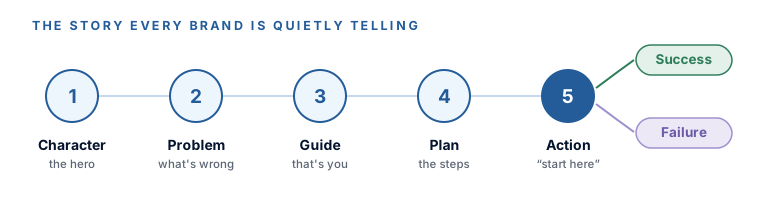
- 1. Character (the hero). Your customer, and the one thing they really want.
- 2. Problem. What’s standing in their way. (This one has three layers — see below; it’s the most important beat.)
- 3. Guide. You — showing you both understand them (empathy) and can actually help (authority: results, experience, proof).
- 4. Plan. The simple 3–4 step path to working with you. People buy when the road looks easy.
- 5. Call to action. The one clear thing you want them to do (“Book a call”), plus an easy first step for the not-yet-ready (“Download the guide”).
- 6. Failure. What it quietly costs them to do nothing. This is the stakes — the reason to act now.
- 7. Success. The happy ending — what their life or business looks like once you’ve helped.
The three-layer problem (the part most people miss)
The “problem” beat is where brands come alive, because a real problem has three layers. Take a homeowner with a roof leak:
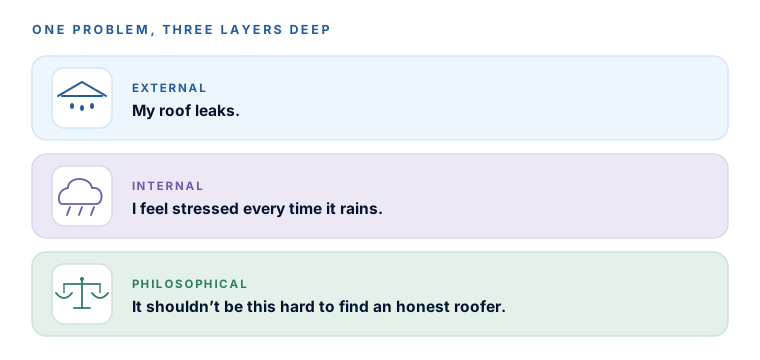
- External — the practical thing: “My roof leaks.”
- Internal — how it makes them feel: “I feel stressed every time it rains.”
- Philosophical — the bigger belief: “It shouldn’t be this hard to find an honest roofer.”
Most businesses only ever talk about the external problem (“we fix roofs”). The brands people love speak to all three — they fix the leak, calm the stress, and stand for something (“honest work, plainly priced”). When we build your strategy doc, we’ll pull all three layers out of you deliberately.
StoryBrand got a refresh in January 2025 (“StoryBrand 2.0”). The good news: the seven parts didn’t change — it just sharpened the language. So what you’re learning is current, and it’s the framework as revised in the latest edition.
Why this pays off later
The document you’re about to build isn’t homework you file away. It becomes the context you feed every future AI decision — your logo prompts, your colour choices, and above all your website copy. When your site practically writes itself in your own voice later, this is why. Think first; the drawing gets easy.
You can say the core idea out loud — the customer is the hero, I’m the guide — and you get why we’re doing strategy before visuals. That’s the whole mindset shift. Next: the 15 questions that pull your strategy out of you.
Watch this step
If you'd rather hear the whole idea before you read on, this is the clearest seven-minute tour of the StoryBrand framework — the same customer-is-the-hero story you're about to build your brand around. It’s from an independent creator — credited below, so go give them a follow.
the StoryBrand Framework Explained In 7 Minutes
More learning resources
Still want another angle? These are hand-picked and vetted to line up with this lesson — from creators and sites worth your time.